
Is this wallet really theirs?
Paste any crypto address before you send. We tell you whether its owner proved it's theirs, whether it's a listed company's wallet, or whether it only looks like one.
Works for Bitcoin, Ethereum and every EVM network, Solana, Tron, XRP, TON, Cardano, Cosmos, Sui, Aptos and more. The address you check isn't kept. Want your own wallet to show as verified? Get verified.

Live figures, updated every minute.
Bitcoin, Ethereum, Solana and every chain in between.
Sign with the wallet you already use: no transaction, no fee. One certificate for an Ethereum-style 0x address covers it on every EVM network.
 Bitcoin
 Ethereum
 Base
 Arbitrum
 Optimism
 Polygon
 BNB Chain
 Solana
 XRP
 Dogecoin
 Cardano
 TON
 Tron
 Sui
 Litecoin
 Bitcoin Cash
 Cosmos
 Aptos
 Avalanche
 Linea
 zkSync
 Scroll
Is my wallet supported?
Paste any wallet address and we'll tell you straight away. Nothing is sent anywhere except a lookup in our public register.
Wallets you can use
Any wallet you hold the keys for, in your browser or on your phone. No wallet? Make one with your email in seconds, or see the wallet guide to check what you have and where to get one.


Three steps. About two minutes.
No forms to fill in and nothing to install if you don't want to. Bring a wallet or make one with your email.
Connect or create a wallet
Use MetaMask, Rabby or Coinbase Wallet for EVM, Phantom, Solflare or Backpack for Solana, or create a secure wallet with just your email.
Sign and pay
Sign a one-time message in your wallet (free, no gas, nothing moves), then pay securely with Stripe.
Share your certificate
Get a permanent certificate page and ID. Anyone you share it with can check both signatures in their own browser.
Two signatures. One proof.
Here's what actually happens when you get verified, and why anyone can check it without asking us.

Your wallet signs a one-time message. It names your wallet and a random nonce. Signing is free, needs no gas, can't move funds, and only the holder of the private key can do it.
We counter-sign the certificate. Your signature goes into the certificate's core, and VerifiedWallet seals that whole core with an ES256 signature. Change one character and the seal breaks.
Anyone can check both, in their own browser. The certificate page recovers your wallet from your signature and checks our seal against the public key we publish. Nothing is taken on trust from our server.
See a certificate before you buy one.
One example of each tier, exactly as a real certificate looks once it's complete. Open one and watch both signatures being checked in your browser.
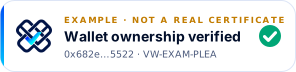
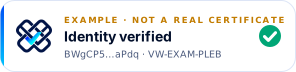
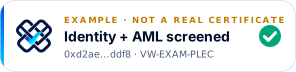
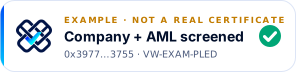
Pay once. Prove forever.
One-time prices, no subscription. Your certificate page stays up permanently. See an example of each.
Wallet Certificate
- Cryptographic proof you control the wallet
- Counter-signed and publicly verifiable
- Permanent certificate page and ID
Verified Identity
- Everything in Tier 1
- Identity verification (KYC) on the certificate
- Updates automatically once reviewed
ID check by Didit, about two minutes. We never see your documents.
AML Screened
- Everything in Tier 2
- Identity screened against sanctions and PEP lists
- Wallet screened on-chain for sanctions, mixers and stolen funds
Company Certificate
Proof that your company controls a wallet, including multi-signature wallets, for counterparties, banks and auditors.
- Multi-signature wallets: Safe, Bitcoin, XRP and Tron, each key-holder signs
- Or any single-key wallet we support
- Company checked against its official registry
- Directors and owners identity-verified (never named)
- Wallet screened on-chain where the network allows
Proof that holds up without us.
Every certificate carries two signatures over the same data. Check them in any browser, or offline with standard tools. If we disappeared tomorrow, your proof would still verify.
- Your wallet signs firstAn EIP-191 signature that only the holder of the private key could produce.
- We counter-signAn ES256 signature over the certificate, checkable against our published public key.
- Anyone can look it upSearch the public register by wallet address or certificate ID.
// the signed core of a certificate
{
  "id": "VW-7K3Q-M2XA",
  "tier": 2,
  "wallet": "0x71c7…976f",
  "walletSignature": {
    "message": "VerifiedWallet certificate request…",
    "signature": "0x4f1a…9c1b"  // EIP-191
  },
  "kyc": { "status": "verified" },
  "issuedAt": "2026-10-13T09:41:00Z"
}
// attestation
{ "alg": "ES256", "sig": "MEUCIQDx3f…" }
One link instead of a screenshot.
Whenever someone asks "is that really your wallet?", send them your certificate.
P2P and OTC trades
Show a counterparty the wallet they're paying belongs to you before funds move.
Getting paid in crypto
Give clients and employers a payout address they can verify, not just copy and hope.
Communities and allowlists
Accept wallets that have proved who controls them, with identity where it matters.
Onboarding and compliance
Collect wallet ownership proof in a standard, signed format your team can check.
Good to know
Which blockchains and wallets can I certify?
EVM: any Ethereum-style address, the kind that starts with 0x. The same address works on Ethereum, Base, Arbitrum, Optimism, Polygon, BNB Chain, Avalanche, Linea, zkSync, Scroll and every other EVM network, so one certificate covers it on all of them. Sign with MetaMask, Rabby, Coinbase Wallet or an email wallet made here.
Smart-contract wallets: Safe multisigs (connect the Safe app with "Use a wallet on your phone"), Coinbase Smart Wallet and other smart accounts on Ethereum, Base, Arbitrum, Optimism, Polygon, BNB Chain, Gnosis, Avalanche, Linea and Scroll. These live on one network, so the certificate names that network and is checked live against the account.
Solana: any Solana address, signed with Phantom, Solflare or Backpack.
Bitcoin: single-key addresses starting bc1q, bc1p (Taproot), 3 or 1. Sign with Xverse, Leather or Unisat in your browser, or by hand in Electrum, Sparrow, or with a Trezor or Ledger through Sparrow. Multisig and other script addresses can't be verified yet. The wallet guide shows how to check which wallets you have in Chrome and where to get one.
Dogecoin, Litecoin and Bitcoin Cash: single-key addresses (D…; ltc1…, L… or M…; bitcoincash:q…), signed by hand in Dogecoin Core, Electrum-LTC or Litecoin Core, or Electron Cash.
Cosmos: Cosmos Hub, Osmosis, Celestia, dYdX, Noble, Sei, Akash, Stride and Juno addresses, signed with Keplr or Cosmostation. Each chain has its own address, so the certificate names the chain.
Cardano: regular mainnet accounts (addr1…, or a stake1… stake address), signed with Eternl, Lace, Yoroi, Vespr, Typhon or another CIP-30 browser wallet.
XRP Ledger: classic accounts (r…), signed with GemWallet or Crossmark. Xaman support is planned.
TON: any TON wallet address (UQ… / EQ…), with Keeper (formerly Tonkeeper), Walt (formerly Telegram Wallet), My Wallet (formerly MyTonWallet), Tonhub or another TON Connect wallet. Approving the connection is the proof.
Tron: any Tron address (starting T), signed with TronLink, including the USDT addresses people use for payments. A Ledger connected to TronLink works too.
Sui: any Sui address (0x and 64 characters), signed with Slush (formerly Sui Wallet), Suiet, Phantom, Nightly or another Sui browser wallet. zkLogin and multisig accounts can't be verified yet.
Aptos: any Aptos account (0x and 64 characters), signed with Petra, Nightly, Pontem or another Aptos browser wallet. We check on the Aptos network that the key you signed with still controls the account. Keyless (Google or Apple) accounts can't be verified yet.
Use the "Is my wallet supported?" checker above if you're not sure.
Can I certify my exchange address (Binance, Coinbase.com, Kraken…)?
No. A deposit address on an exchange belongs to the exchange, and only the exchange holds its keys, so you can't sign with it. Certify a wallet you control yourself, such as MetaMask, a hardware wallet, or an email wallet made here.
Can I use a wallet app on my phone?
Yes, for EVM wallets. Choose "Use a wallet on your phone" when you get verified. On a computer, scan the QR code with MetaMask, Trust, Rainbow, Coinbase Wallet or hundreds of other apps that support WalletConnect. On your phone, it opens the wallet app directly.
Smart-contract accounts work too: connect a Safe through the Safe app this way, or use Coinbase Smart Wallet with a passkey.
Can I use a hardware wallet like Ledger or Trezor?
Yes. Connect it through MetaMask or Rabby as you normally would, and confirm the signature on the device.
Does getting verified cost gas or touch my funds?
No. You sign a plain text message, which happens off-chain: no transaction, no gas, and nothing can move. The only cost is the one-time certificate price.
What exactly does a certificate prove?
That whoever requested it controlled the wallet's private key at the time, because they produced a valid signature with it. Tier 2 also records the outcome of an identity review. It isn't financial advice or an endorsement of the holder.
Do you ever get access to my wallet or keys?
No. You sign a plain text message in your own wallet. Signing costs nothing, needs no gas and can't move funds. If you create a wallet with your email, it's non-custodial: we never see its private key.
How does someone check my certificate?
Send them your certificate link. The page checks both signatures in their browser against our published public key, and shows the result. They can also search the register by your wallet address.
Can I show my certificate on my website?
Yes. Every certificate page has an "Add a badge to your site" box with a live badge in card or pill style, light or dark, and the HTML or Markdown to paste. The badge links back to your certificate and changes if its status ever changes.
How does identity verification work?
Tiers 2 and 3 use Didit, an identity verification provider. You photograph your ID document and take a short selfie video in Didit's secure flow, which takes about two minutes. We receive only the result, never your documents or face scan, and Didit deletes your verification data after 30 days.
Can a certificate be revoked?
Yes, for example if it was obtained fraudulently. A revoked certificate is marked REVOKED on its page and in the register, while its original signatures stay intact.
Proving a wallet is yours, explained.
How to prove you own a Bitcoin address
Sign a message with the address's key: free, instant, nothing on the blockchain.
How to prove you own an Ethereum wallet
One signed message, no gas, and it covers every EVM network at once.
Is it safe to sign a message with your wallet?
How to tell a harmless message from an approval or permit in disguise.
More chains. More wallets.
Here's what we're working on next. Today's certificates cover Bitcoin, every EVM address, Solana, XRP, Cardano, TON, Tron, Sui, Dogecoin, Litecoin, Bitcoin Cash, Cosmos and Aptos, plus multi-signature wallets for companies.
More chains
Further networks such as Polkadot, NEAR and Stellar, prioritised by what our customers ask for.
Xaman for XRP
Sign in with Xaman, the most used XRP Ledger wallet, on your phone. GemWallet and Crossmark work today.
Taproot multisig
Newer Bitcoin vaults (Taproot and MuSig2). Standard multisig wallets work today on the Business tier.
Your wallet. Proven.
Get a certificate in about two minutes, from $1.